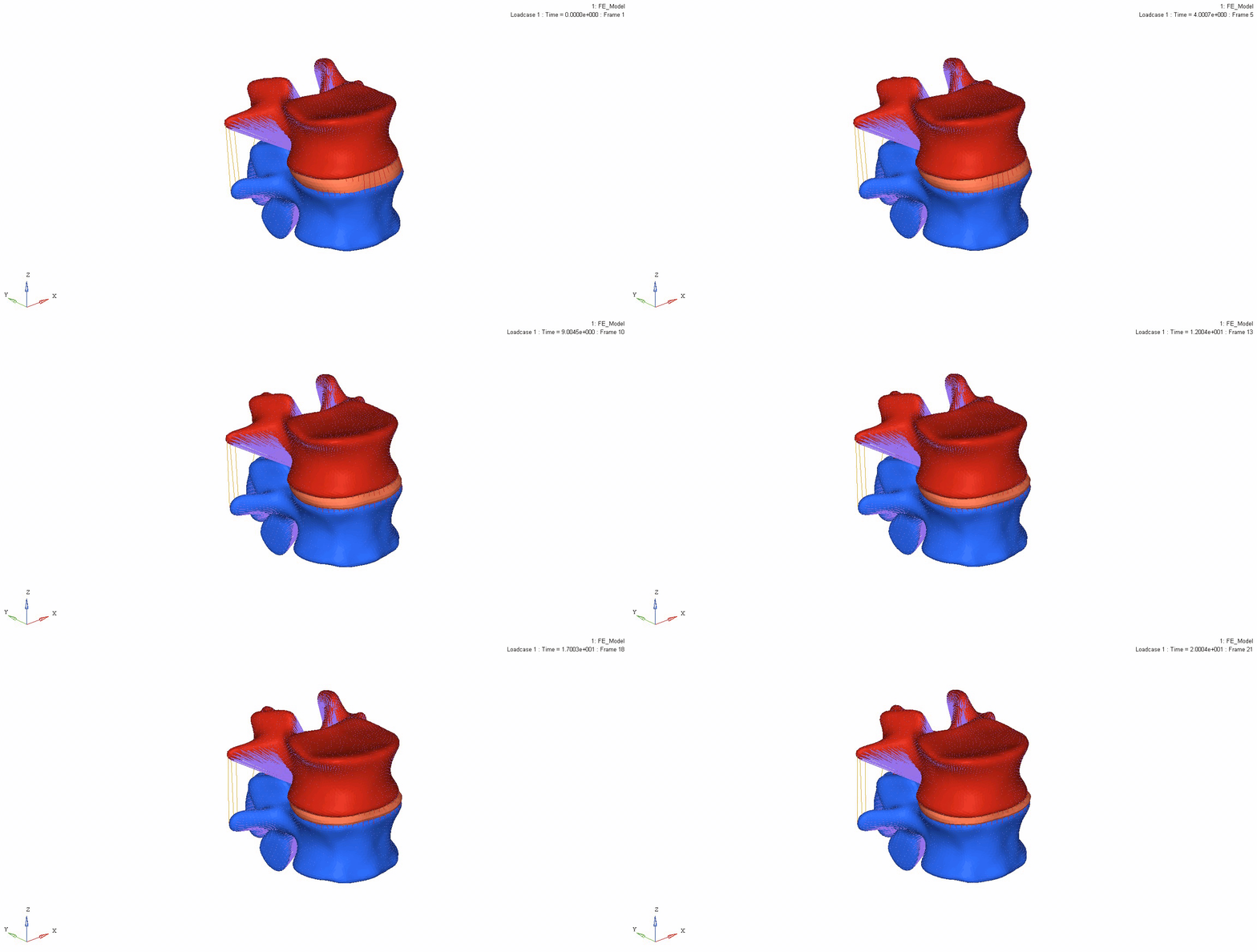
For my master thesis at ETH Laboratory for Orthopaedic Biomechanics, I collaborated with Balgrist University Hospital to develop an advanced surgical planning tool. The project involved incorporating soft tissue structures into a MATLAB pipeline for the automated creation of subject-specific finite element (FE) models. The FE simulation outputs were validated against biomechanical experiments, ensuring enhanced precision and reliability for orthopaedic applications.
Computer models offer great potential for assisting surgeons in pre-operative planning. For an accurate representation of the spinal column, the characteristics of soft tissue have to match the patient’s constitution as close as possible. In stepwise reduction experiments, Widmer et al. were able to determine the ligament contribution for all loading directions along the major axes. Previous work showed that it is possible to predict subject-specific intervertebral disc properties by only three parameters: the disc area, spinal level and CT annulus intensity. Together with the aforementioned experimental results, this information can be used to also predict the behaviour of ligaments during physiological loading conditions.
Specimen-specific force-displacement curves for the spinal ligaments were incorporated into finite element (FE) models of 30 segments (vertebra-disc-vertebra). The ligaments were modelled with sets of springs and the insertion points on the vertebrae were placed according to their anatomical distribution in the general population. The loading conditions from the stepwise reduction experiments were replicated in the FE models and the obtained in silico results were compared with the in vitro findings.
The generated ligament moment contribution curves have been in the predicted range for 21 out of 24 observed scenarios. For the most relevant motion patterns, flexion and extension, all ligaments provided stability in the target range. In addition, we have been able to demonstrate that the implementation of individual ligament properties shows substantial improvement over the usage of literature values.
This work contributes to more accurate modelling of patient-specific features in biomechanical simulations, which has the potential to improve overall functional analysis and outcome prediction in the clinical decision-making process.
Please contact me if you are interested in further details.